

News
Report on Book Launch: Transatlantic Practices of Fascism(s) and Populism(s) from the Margins
Eirini Arampatzi, Amber Bader, Cathy Box, Dorien van Gerven, and Anouck Masse, Research Master’s Programme Comparative Literary Studies.
On March 10th, the Utrecht Forum for Memory Studies hosted the book launch for Transatlantic Practices of Fascism(s) and Populism(s) from the Margins. Towards a Transcultural Aesthetics of Postmigration and Antifascism, edited by Reindert Dhondt, Monica Jansen, and Maria Bonaria Urban.
As part of a masterclass in the RMA Comparative Literary Studies, this event brought authors and respondents together to reflect on the publication of this volume. Moderated by students Eirini Arampatzi and Anouck Masse, the discussion was joined by Jonas Staal and Julienne Weegels who were able to participate online to give a short presentation on their chapters. Joost de Bloois, who also authored a chapter, attended in person to introduce his chapter alongside respondents Frans Willem Lantink and Rick Dolphijn.
The volume is structured in four parts, with the first two addressing different genealogies, practices, and discourses of fascism(s) and populism(s) and the latter two focusing on representations and testimonies.
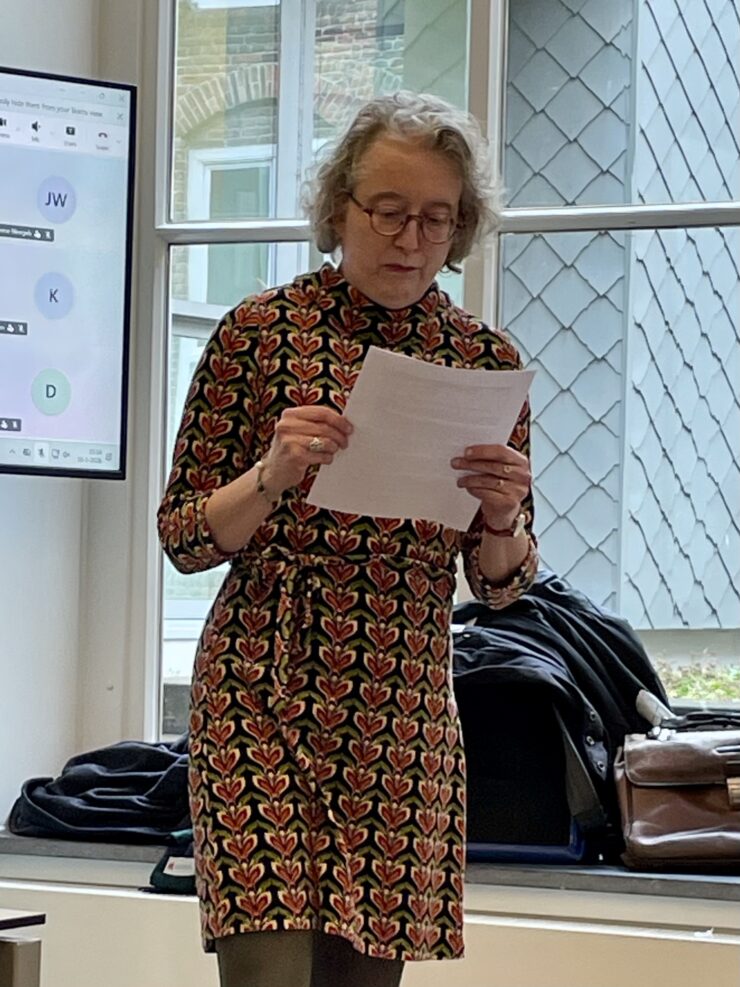
Both respondents from Utrecht University highlighted different aspects of the volume complementary to their academic backgrounds, facilitating an interdisciplinary dialogue. Frans Willem Lantink, as a political historian, reflected on the volume focusing on the different genealogies of fascism. In contrast, Rick Dolphijn dealt with the chapters in part four discussing testimonies informed by his own work on Deleuze, Guattari and fascism with Rosi Braidotti.
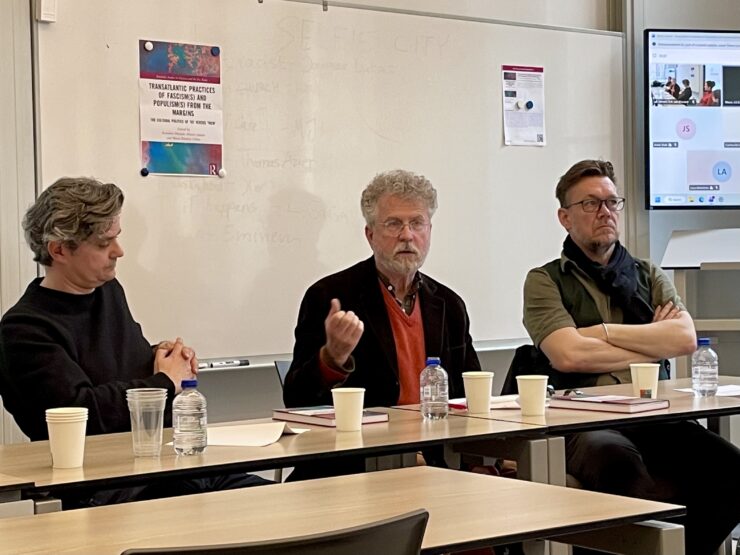
During his talk, De Bloois, professor of cultural and literary analysis at the University of Amsterdam, whose research focuses on the nexus between art and politics, reflected on the controversies on the murder of Italian film director Pier Paolo Pasolini (1922-1975) to highlight how his anti-capitalist approach of the marginalized could also serve populist purposes. He also explored the argument made in his chapter on how Italian philosopher Giorgio Agamben (1942-) constructs the notion of “the people” and “the People”. This distinction reveals a populism of particularity that emphasizes the power of local culture as opposed to the power of the state. Julienne Weegels, a scholar in Latin American Studies at the University of Amsterdam and an ethnographer specializing in Nicaragua, provided an enlightening presentation that complemented her chapter that focuses on the different ways the Nicaraguan government and its supporters and those protesting against the government in the 2018 protests constructed an “Us” versus “Them” binary, a central thread running through the entire volume, by appealing to the legacy of the Sandinista revolution. In her presentation, she summarised the key points of her chapter and highlighted the imagery used in coverage of the protests. She reflected on the sanitisation of revolutionary movements through the case study of the 2018 protests. Artist Jonas Staal, whose work explores the relationship between art, democracy, and propaganda, reflected in his presentation on the construction of the “Us” vs “Them” divide as constructed in repressive Nazi propaganda and in democratic news coverage. To illustrate this divide, he discussed the film Der Ewige Jude in contrast with contemporary news articles in The Guardian on China and Russia and their leaders and highlighted how both are forms of propaganda that portray “Them” on the one hand as fearsome enemies that need to be destroyed and on the other as incompetent individuals easily conquered and ridiculed.
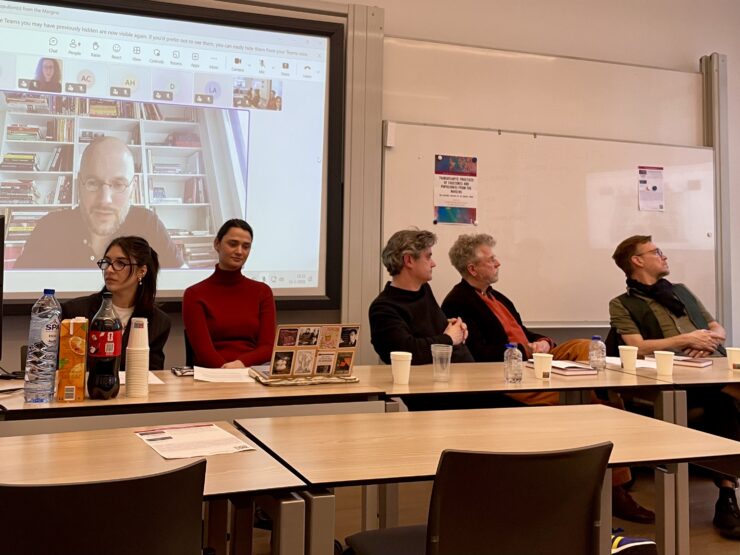
The discussion moved from embodiment, as showcased in Julienne Weegels’ work, where she analysed the different roles different bodies play in protests and the sanitisation of representations of the bodies in protests, to De Bloois’ discussion of the role of technology in right-wing spaces as conceptualized by Agamben to Staal’s reflection on the tension between literary forms of political resistance and his parliamentary artworks as opening spaces for unheard voices. These discussions not only deepened our understanding of the importance of analyzing fascism from the margins, but also made us aware of “the fascist inside of us”. In other words, it made us aware of the fact that living the anti-fascist life is a double-edged sword.
What made this event particularly special was the way it brought together scholars, artists, and students across disciplines and formats, creating a dynamic exchange. The deep engagement between contributors and respondents turned the presentation of the volume into a critical dialogue, leaving the audience with new perspectives and open questions, inviting them to interpret and reflect on the dynamics of fascism and populism in relation to their own social and political contexts.